Polo shirt manufacturing in China: pique, collars, buttons and the full specification
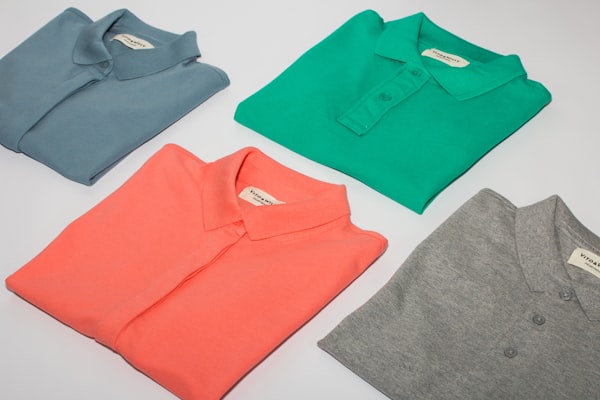
A polo shirt looks close to a t-shirt but is a different product in manufacturing. A t-shirt is one piece with simple construction; a polo adds three components, each with its own specification and its own failure modes: the collar, the button placket, and the buttons themselves. Most complaints from polo importers trace back to those three rather than to the fabric.
The fabric: why pique?
Pique is a raised textured knit and the traditional polo fabric for practical rather than purely aesthetic reasons: it breathes better than flat jersey because its structure leaves air channels, it hides creasing so the garment still looks tidy after hours of wear, and it survives the repeated laundering of corporate use. Common weights run 180 to 220 grams per square metre, heavier than a t-shirt because a polo is expected to hold its shape. The alternatives are flat jersey for a smoother, more formal look, and a polyester blend for corporate use where dimensional stability matters more than a natural hand.
The collar: the most important component and the most likely to fail
The collar is knitted separately, not cut from the body fabric. The decisive difference between a good and a poor polo is whether the collar still stands after twenty washes or goes soft and wavy. Ask explicitly for a rib-knit collar at an appropriate density, with a shape-retention test after a stated number of washes. Also specify the collar height in centimetres, whether it has a plain edge or a tipped stripe, and whether its shade matches the body exactly, because the collar is dyed in a separate lot and can arrive a shade off, which ruins the whole garment.
The placket and the buttons
The placket is the band carrying the buttons at the chest opening. Specify its length in centimetres, the number of buttons (usually two or three), and whether it is concealed or exposed. For the buttons, specify the material (natural shell or polyester), the size, the colour, the number of holes, and require reinforcement behind each button position. A recurring defect in cheap polos is buttons coming off after a few weeks because the stitching was not locked properly.
Other details to request explicitly
- Side vents: a small opening at the hem on both sides, with a reinforcement tape that stops it tearing.
- A longer back hem: traditional on a polo so it stays tucked in during movement.
- Ribbed sleeve cuffs: matching the collar, rather than a folded hem.
- A spare button: stitched inside the garment or supplied in a small bag.
Printing and embroidery on polos
Embroidery dominates on polos, especially in corporate use, because it reads as quality and survives washing. It is priced by stitch count with a one-off digitising setup fee. The standard placement is the left chest. Avoid large heat transfers on pique, because its uneven surface makes the print break up.
Sizing
Customers judge a polo more like a shirt than a t-shirt and expect a more precise fit. Write a full chart covering chest width, body length, shoulder width, sleeve length, collar circumference and placket length. Do not assume your t-shirt chart transfers.
Frequently asked questions
What is the minimum order? Usually a little higher than a t-shirt, 200 to 300 pieces per colour, because collars and buttons carry their own minimums.
Why is a polo more expensive than a t-shirt? Heavier fabric, a separately knitted collar, a placket and buttons, and additional sewing operations.
Can I have a contrast collar? Yes, but it is dyed in a separate lot, so ask for an approved colour sample covering the collar and the body together.
We supply wholesale polo shirts to a complete written specification covering the collar and buttons, with an approved sample before production.
More articles